 comparison
Vinyl Fence Installation Cost Per Foot: 2026 Guide
Table of Contents
- Vinyl Fence Installation Cost Per Foot in 2026
- Materials vs. Labor: What the Installed Price Actually Covers
- Vinyl Fence Installation Labor Cost: What Drives the Crew Hours
- Vinyl Fence Cost for 200 Feet: A Full Project Example
- Vinyl Fence vs. Wood Fence Cost: Upfront Price and Long-Term Ownership
- How to Read a Vinyl Fence Installation Estimate Line by Line
- Conclusion
- Frequently Asked Questions
Last Updated: October 8, 2026
Vinyl Fence Installation Cost Per Foot in 2026
Vinyl fence installation cost per foot in 2026 runs roughly $45 to $79 per linear foot fully installed, based on published cost guides from Angi, Homewyse, and Ergeon. That covers standard 4- to 6-foot heights, professional labor, posts, concrete, and panels, but not why two neighbors with identical yards can get quotes that differ by thousands of dollars.
The gap almost never comes down to the material. It comes down to what each contractor quietly leaves out of the estimate.
Below, we break down the published ranges, what the installed price pays for, and how to read a quote line by line.
Published Price Ranges From Major Cost Guides
The spread across national cost guides is wide. Angi reports $15 to $40 per linear foot for standard 4- or 6-foot vinyl fencing, with project costs between $2,340 and $5,996. Homewyse lists $55.93 to $79.02 per linear foot as of September 2026. The Home Depot breaks its guide out by height: $45 to $119 per linear foot for 4-foot fencing, $66 to $125 for 5-foot, and $85 to $139 for 6-foot, with vinyl panels averaging $72 to $111 each.
Ergeon, which publishes pricing from its own 2026 installations, reports $45 to $74 per linear foot installed, with about $55 per linear foot as typical. Those numbers describe different projects more than they contradict each other.
Why Published Ranges Disagree So Much
Three things explain most of the gap between a $15-per-foot quote and a $79-per-foot quote.
Height and style. A 4-foot basic picket fence and a 6-foot tongue-and-groove privacy fence are not the same product. The Home Depot's height-based ranges show the low end of 4-foot pricing sitting tens of dollars per foot below the low end of 6-foot pricing.
What's included. Some guides quote material only; others include labor, posts, concrete, and gates. A materials-only figure presented as an installed price is the most common source of sticker shock.
Regional pricing. Local labor rates, permit requirements, and supplier costs vary by market. A national average is a starting point, not a quote.
Materials vs. Labor: What the Installed Price Actually Covers
An installed vinyl fence price has two components: materials and labor. Materials include panels, posts, rails, caps, gate hardware, and post concrete. Labor covers excavation, post setting, panel assembly, gate hanging, and cleanup.
When you compare a materials-only price to an installed price, you are comparing two different things. The Federal Trade Commission's guidance on home improvement contracts is worth reading before you sign anything, because it lays out what a written contract should specify.
How Much of a Vinyl Fence Quote Is Labor?
Labor makes up a substantial share of an installed vinyl fence price, though the split depends on site conditions and fence style. If you see a materials-only figure and an installed figure for the same fence, the difference is your labor and installation cost, and that difference is where most of the variation between contractors lives.
Vinyl Fence Installation Labor Cost: What Drives the Crew Hours
Most published guides quote a single installed number and never separate the labor inside it, the number you actually need, because labor is what swings between contractors on an identical fence.
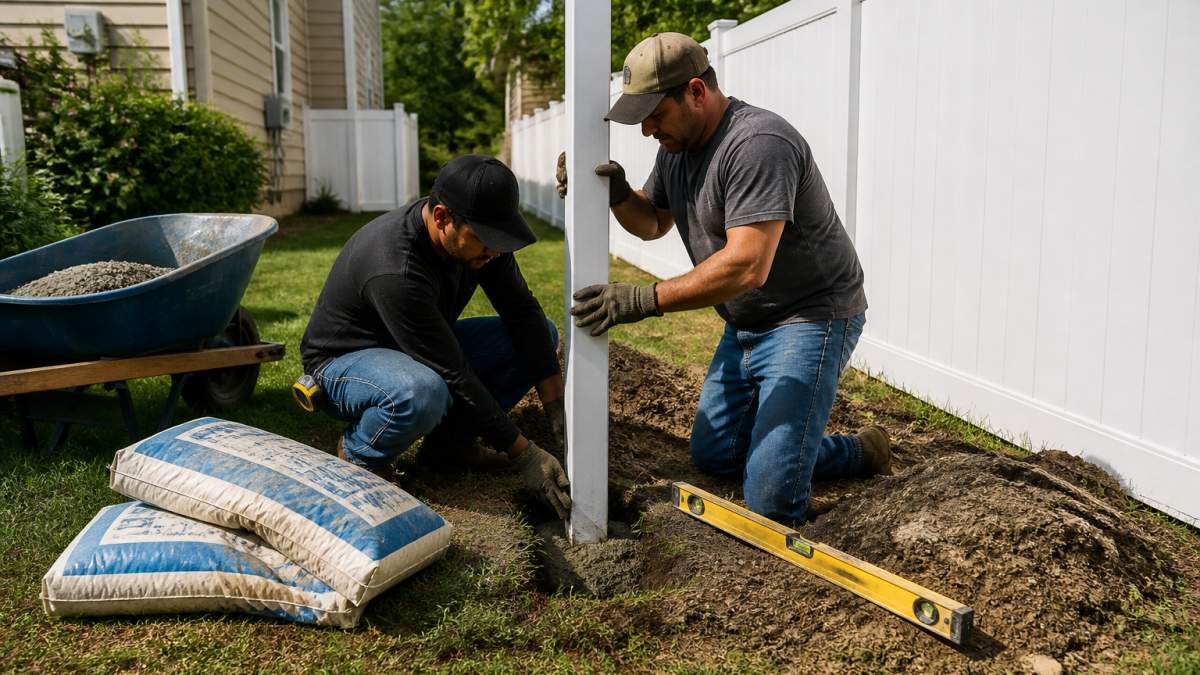
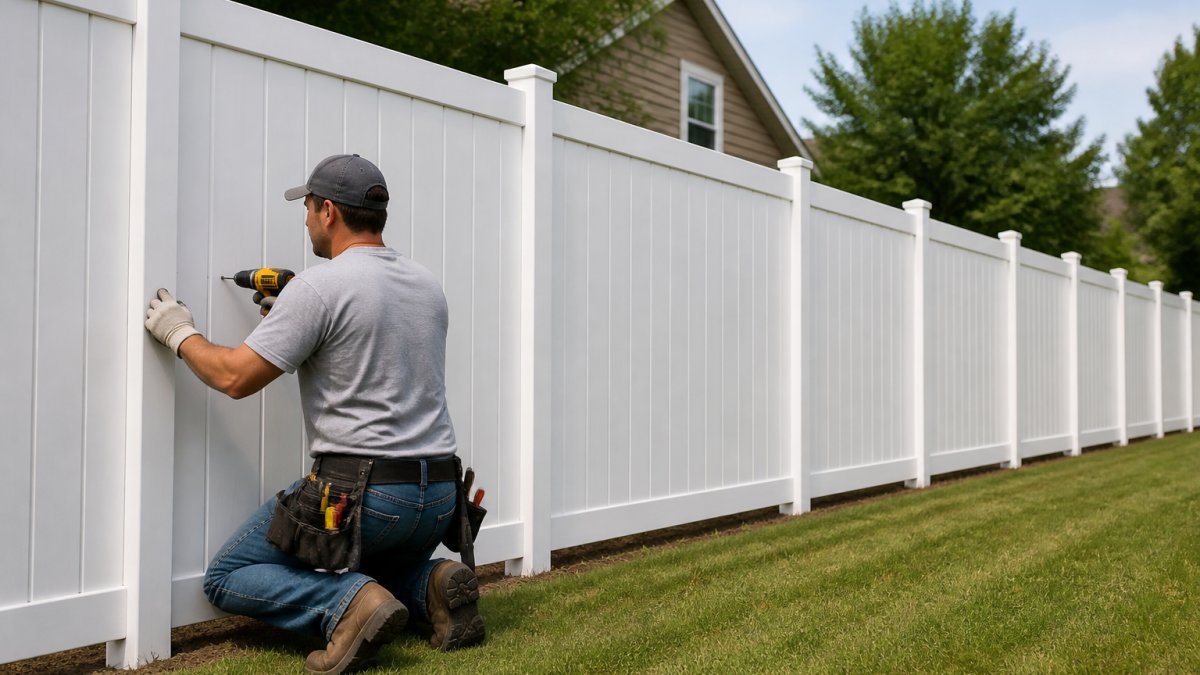
Linear footage and layout. A straight 100-foot run sets faster than the same footage wrapping three corners. Every corner needs an extra post, hole, and concrete pour, plus time squaring and bracing the turn.
Post spacing and depth. Standard spacing is 6 to 8 feet on center, so a 200-foot run needs roughly 25 to 34 posts before corners and gate posts.
Site access. A backyard reachable by truck and wheelbarrow is a different job than one behind a locked gate with a slope and mature landscaping.
Fence height and gauge. Taller fences need deeper posts and heavier panels.
Here is how a transparent labor estimate breaks down for a 200-foot project:
| Labor Line Item | What It Covers | What Changes It |
|---|---|---|
| Layout and marking | String lines, utility locate coordination, corner staking | Corners, curves, and slope |
| Excavation | Digging each post hole to depth | Soil type, rocks, frost depth |
| Post setting | Placing posts, mixing and pouring concrete, bracing | Post count and hole depth |
| Panel and rail assembly | Cutting, fitting, and fastening sections | Height, style, and gauge |
| Gate hanging | Setting gate posts, mounting frame and hardware | Gate count and gate type |
| Cleanup and haul-away | Site cleanup and debris disposal | Old fence removal and access |
When you get quotes, ask for the labor portion as its own line.
Vinyl Fence Cost for 200 Feet: A Full Project Example
A 200-foot vinyl fence project is the most common size we quote. Using published per-foot ranges, a 200-foot run at $45 per foot lands near $9,000, while the same run at $79 per foot lands near $15,800. That gap reflects height, style, gate count, and site conditions.
Here is how a transparent estimate breaks down for a 200-foot project:
| Line Item | What It Covers | Why It Changes |
|---|---|---|
| Panels | Vinyl panel sections at the quoted height | Height and style drive panel cost |
| Posts and rails | Structural posts and horizontal rails | Post spacing and height change the count |
| Concrete | Per-post concrete for setting | Frost depth and hole size change volume |
| Gates | Gate frame, hardware, and hanging | Walk gates and drive gates price differently |
| Labor | Excavation, setting, assembly, cleanup | Site access and layout change crew hours |
| Permits and haul-away | Local permit fees and old fence removal | Varies by jurisdiction and debris volume |
A 200-foot project with one walk gate and a straight, accessible run will sit near the low end. The same footage with a double drive gate, three corners, and a slope will sit near the high end.
Vinyl Fence vs. Wood Fence Cost: Upfront Price and Long-Term Ownership
Vinyl usually costs more upfront than wood and less over time. A wood privacy fence installs for meaningfully less per foot than comparable vinyl, while vinyl is expected to last considerably longer with far less upkeep. The gap narrows or reverses once you add a decade of maintenance to the wood side.
Here is the ownership math most guides skip. Wood fencing needs staining or sealing every few years to slow rot and graying, and boards and posts eventually need replacement. Vinyl does not rot, does not need painting, and cleans with a hose.
Repair changes the comparison again. Wood fails at the base where it meets soil, so a rotted post means digging out concrete and resetting. Vinyl panels and posts can be replaced individually, and a cracked panel is a swap rather than a rebuild.
| Ownership Factor | Wood Fence | Vinyl Fence |
|---|---|---|
| Upfront installed cost | Lower per foot | Higher per foot |
| Routine maintenance | Stain or seal every few years | Occasional rinse |
| Rot and insect damage | Common at ground contact | Not susceptible |
| Typical repair | Replace rotted boards and posts | Replace individual panel or post |
| Repainting | Needed periodically | Not needed |
| Expected service life | Shorter without upkeep | Longer with minimal upkeep |
Two caveats keep this honest. Vinyl is not maintenance-free: it can chalk, fade, or crack under impact, and a warranty matters more than the marketing claim. Wood offers a natural look many homeowners prefer and easier on-site customization. The right answer depends on how long you plan to stay and how much upkeep you will do.
For homeowners weighing material durability and outdoor water use, the U.S. Department of Energy's guidance on outdoor water and material durability is a reasonable starting point, and the Federal Trade Commission's guidance on home improvement contracts is worth reading before you sign anything, because it lays out what a written warranty and contract should specify.
How to Read a Vinyl Fence Installation Estimate Line by Line
A vinyl fence installation estimate should let you compare quotes apples to apples. Most do not. Use this checklist:
- Does the quote state fence height and style by name?
- Does it list post spacing and post depth?
- Is concrete for posts included, or billed separately?
- Are gates itemized by type and count?
- Is old fence removal and haul-away included?
- Are permits included, or is that your responsibility?
- Does it state the vinyl gauge and manufacturer?
- Is there a written warranty on both materials and labor?
If a contractor will not put post depth, gauge, and inclusions in writing, that is your answer.
Conclusion
The hardest part of pricing a vinyl fence is not finding a number. It is finding a number you can trust, from a contractor who will still be around when a post needs attention. We are family owned and operated, we never subcontract our work, and we have over 30 years of experience. We are fully licensed, insured, and bonded, and we back our quotes with a price matching policy. Get started with Fence Company Lincoln and get an itemized estimate you can actually compare.
Frequently Asked Questions
How much does it cost to install 200 feet of vinyl fence?
Published guides put vinyl fence cost at roughly $45 to $74 per linear foot installed, so a 200-foot run often lands somewhere between $9,000 and $14,800 before gates, corner posts, or site-specific work. The spread is wide because PVC grade, panel style, fence height, and local labor rates all move the number. Ask for a written vinyl fence installation estimate that lists linear footage, post spacing, concrete per post, and gate count so you can compare quotes on the same scope.
How much of a vinyl fence installation quote is labor?
Labor usually makes up a meaningful share of the installed price, but the exact split depends on the market, crew size, and how much site work the job needs. Digging post holes, mixing concrete per post, setting panels, and hanging gates all consume crew hours. A detailed quote separates vinyl fence installation labor cost from materials so you can see what you are paying for. If a quote only shows one lump sum, ask the contractor to itemize it before you sign.
Is it cheaper to install a wood or vinyl fence?
Wood typically costs less upfront, while vinyl costs more per foot at installation. The vinyl fence vs. wood fence cost comparison changes over time because wood needs staining, sealing, and board replacement, and it can rot at the base in wet soil. Vinyl needs occasional cleaning but no painting or sealing. For homeowners planning to stay in the home for years, the lower maintenance bill often narrows or closes the upfront gap. Get both quotes in writing before deciding.
What factors make vinyl fence installation more expensive?
Fence height and panel spacing matter first: taller fences need longer posts and more material. Style also drives price, since tongue-and-groove privacy panels cost more than a basic three-rail or picket fence. Site access is another big one, because a crew hauling panels by hand across a sloped or fenced yard takes longer than one backing a truck up to the line. Rocky soil, old concrete footings, and extra gates each add labor and material.
Does vinyl fencing cost less to maintain than wood?
Yes. Vinyl fencing generally needs only occasional washing, while wood requires periodic staining or sealing and eventual board replacement. That difference shows up in long-term ownership costs rather than the installation quote. Wood that stays wet can rot at the base, which means digging out and resetting posts. Vinyl panels and posts hold up without paint, so the maintenance budget over ten years is usually smaller. Ask your contractor what the installation warranty covers.