 how-to
Why Fence Posts Lean Over Time: Causes and Fixes
Table of Contents
- Common Causes of Leaning Fence Posts
- How to Fix a Leaning Fence Post with Concrete
- Does Homeowners Insurance Cover Fence Repair?
- Cost to Repair a Leaning Fence Post
- Preventing Future Leaning: Installation and Maintenance Tips
- When to Call a Professional Fence Contractor
- Conclusion
- Frequently Asked Questions
Last Updated: September 15, 2026
Common Causes of Leaning Fence Posts
Fence posts lean when the forces holding them upright lose to the forces pushing them over. The cause determines whether a simple reset fixes it or the post needs full replacement.
Most failures trace back to four root causes: soil moisture and drainage problems, frost heave and ground movement, wood rot at the post base, or improper installation. Knowing which caused your lean is the first step toward a lasting fix.
Soil Moisture and Drainage Problems
Soil moisture and drainage problems are the leading cause of fence posts lean over time in most residential settings. Water pooling around a post base softens the soil that provides lateral support, letting the post shift under normal wind load. When that soil stays saturated, it loses bearing capacity, the post tilts, and each rain event worsens the alignment.
Poor drainage around a post shows up in several ways:
- Standing water after rain near the post base
- Soft, spongy ground when you step near the fence line
- Visible soil erosion exposing the concrete footing
- A green moss or algae ring at the base of the post
A drainage swale or French drain uphill of the fence line redirects water before it reaches the posts. For individual posts, regrading the soil to slope away from the base often solves the issue.
Frost Heave and Ground Movement
Frost heave lifts and shifts fence posts when moisture in the soil freezes and expands. In freeze-thaw regions, this can push a post upward by several inches, breaking the concrete footing and leaving the post out of alignment.
Water expands roughly 9% when it freezes (Water Density). If that water sits in the soil around a post-hole, the expansion pushes the post and its footing upward. When the ground thaws, the post rarely settles back, and over several winters it walks out of plumb.
Posts set below the local frost line resist heave because the freezing zone sits above the footing. In many parts of the country that means burying posts at least 36 to 48 inches deep, though your local building department can confirm the exact frost depth. Skipping that depth is why so many fences lean within two or three years.
How to Fix a Leaning Fence Post with Concrete
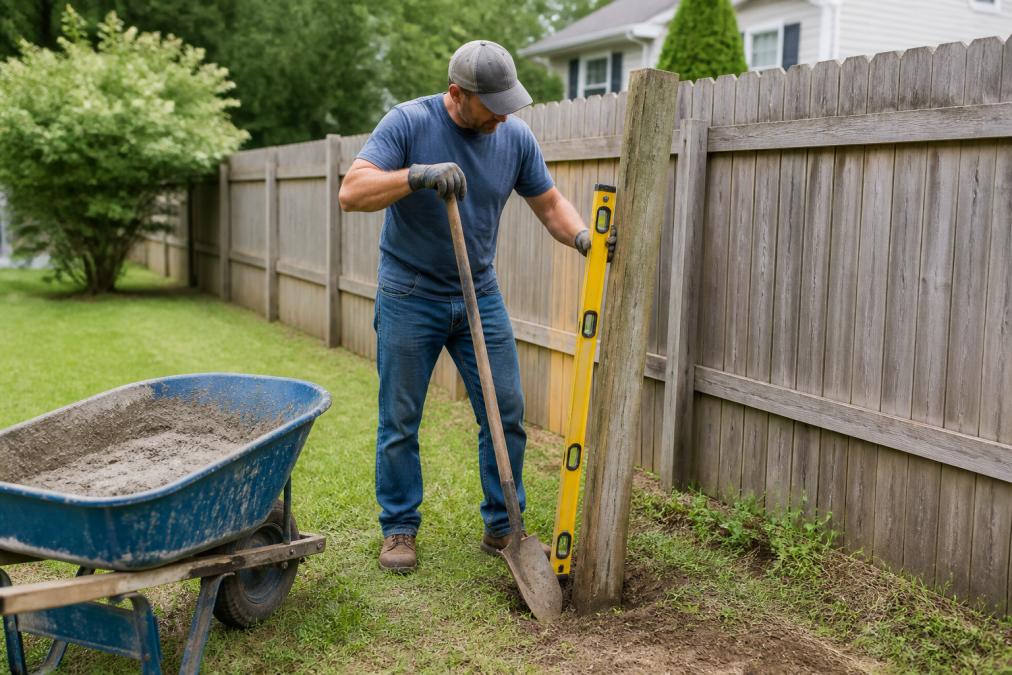
Learning how to fix a leaning fence post with concrete starts with assessing whether the post is salvageable. If the wood is sound and the lean is moderate, you can reset it in a new concrete footing.
Step-by-Step Concrete Repair
Total Time: 3-5 hours (plus 24-48 hours cure time) Difficulty: Intermediate
What You'll Need:
- Post-hole digger or auger
- Level (4-foot minimum)
- Concrete mix (fast-setting or standard)
- Gravel for the base
- Wood braces and stakes
- Shovel and tamper
Step 1: Dig out the post base [Time: 45-60 minutes] Excavate around the post to 24 to 36 inches, exposing the existing footing. Remove cracked or broken concrete.
Step 2: Straighten and brace the post [Time: 20 minutes] Pull the post back to plumb using a level on two adjacent sides. Drive stakes into the ground and brace the post so it holds steady while the concrete cures.
Step 3: Add a gravel base [Time: 10 minutes] Pour 4 to 6 inches of gravel into the bottom of the hole to create a drainage layer that keeps water off the post base.
Step 4: Pour the concrete [Time: 20 minutes] Mix and pour concrete around the post, filling the hole to slightly above grade. Slope the concrete away from the post so water runs off rather than pooling.
Step 5: Cure and backfill [Time: 24-48 hours] Leave the braces in place for at least 24 hours, then backfill around the concrete with soil, tamping it in layers for compaction.
Does Homeowners Insurance Cover Fence Repair?
Homeowners insurance typically covers fence repair only when damage stems from a covered peril such as a storm, falling tree, fire, or vandalism. Gradual conditions like soil settling, wood rot, or normal wear are almost always excluded, and most leaning posts result from slow-moving causes. Treat insurance as a last resort after diagnosing the cause:
- Sudden wind event, a single storm that snapped posts or lifted a panel is the strongest claim scenario. Document the date, wind speed, and damage pattern before cleanup.
- Frost heave, a post pushed up by freeze-thaw cycles is usually classified as earth movement or gradual deterioration, both commonly excluded.
- Soil saturation and drainage failure, slow water damage is maintenance, not a covered peril.
- Wood rot at the post base, decay is gradual deterioration and is nearly always excluded.
- Vehicle impact or vandalism, usually covered under the dwelling or liability portion of the policy.
Check your policy's dwelling coverage section and any exclusions for "earth movement," "gradual deterioration," or "faulty workmanship." The Insurance Information Institute's guide to homeowners policies explains how these exclusions typically work. Before filing, get a repair estimate and compare it against your deductible. For a single leaning post, the repair often costs less than the deductible, making a claim pointless, and a claim can affect your premium at renewal even if it is denied.
Soil Type and Drainage: The Cause Insurers and Contractors Both Miss
The more useful question is why the post leaned in the first place, and that answer usually starts in the soil. Two properties with identical fences can fail at completely different rates depending on what is underground.
Clay soil expands when wet and shrinks when dry, loosening the grip around a post and creating voids that let water collect against the base. A post set in clay can move laterally even without a storm, often showing up as a fence line that waves rather than a single post that tilts.
Sandy soil drains quickly but offers less lateral resistance, so a post in sand needs a wider footing or deeper embedment to resist wind load.
Silt and loam sit between the two and are the most stable when properly compacted, but erode easily if surface water runs along the fence line.
A simple field test tells you which you are dealing with. Dig a small hole near the post base, take a handful of soil, and squeeze it:
- If it holds a ribbon shape and feels sticky, it is high in clay.
- If it crumbles and feels gritty, it is sandy.
- If it holds shape but breaks apart easily, it is loamy and likely the most stable.
Match your repair to the soil: in clay, widen the footing and add a gravel drainage collar; in sand, deepen the embedment and compact backfill in thin layers; in silt or loam, redirect surface water away from the fence line with a swale or shallow French drain.
This is the step most homeowners skip, and it is why a reset post leans again within a season or two.
Cost to Repair a Leaning Fence Post
| Repair Scenario | DIY Approach | Professional Approach | Best For |
|---|---|---|---|
| Single post reset | Dig, brace, repour concrete | Same, with warranty | Handy homeowners with time |
| Multiple posts leaning | Time-intensive, hard to brace alone | Efficient with crew and equipment | Property managers, busy owners |
| Rotted post replacement | Requires new post and footing | Full replacement with disposal | Posts with structural decay |
| Drainage correction | Regrade or add swale | Engineered drainage solution | Recurring moisture problems |
Preventing Future Leaning: Installation and Maintenance Tips
Match the Installation to Your Soil
Choose Materials That Resist the Failure Mode
Seal the Post Base Before Rot Starts
Routine Maintenance That Actually Catches Problems Early
Climate Changes the Timeline
When to Call a Professional Fence Contractor
Signs that professional help is warranted:
Conclusion
Frequently Asked Questions
How to fix a fence post that is leaning over?
To fix a leaning fence post, you can try several methods. For minor leans, you might drive a metal rebar or stake next to the post and secure it. For a more permanent fix, dig around the post, straighten it, and pour new concrete to create a solid footing. If the post is rotted, replacement is necessary. Always check local building codes for depth requirements. For best results, consult a professional fence contractor.
What is the average lifespan of a fence post?
The lifespan of a fence post depends on the material and installation quality. Pressure-treated wood posts typically last 15 to 20 years if properly installed and maintained. Vinyl and metal posts can last 20 to 30 years or more. However, factors like soil moisture, drainage, and climate can shorten that lifespan. Regular inspections and preventative coatings can help extend the life of your fence posts.
How much does it cost to straighten a leaning fence post?
The cost to repair a leaning fence post varies based on the extent of damage, accessibility, and whether you DIY or hire a pro. Minor repairs might cost under $100 in materials, while professional repairs can range from $200 to $500 per post. For accurate pricing, contact a local fence company for a quote. Keep in mind that fixing multiple posts may reduce the per-post cost.
Does frost heave cause fence posts to lean?
Yes, frost heave is a common cause of leaning fence posts in cold climates. When the ground freezes, it expands and pushes the post upward. As it thaws, the soil settles unevenly, causing the post to lean. To prevent frost heave, posts should be set below the frost line with proper drainage. In regions with severe winters, deeper footings and gravel bases can help mitigate this issue.