 how-to
Does Homeowners Insurance Cover Fence Repair? 2026 Guide
Table of Contents
- Homeowners Insurance Fence Damage Coverage: What's Actually Covered
- Coverage B Limits, Deductibles, and How Payouts Work
- How to File a Fence Damage Insurance Claim: A Step-by-Step Checklist
- Is It Worth Filing an Insurance Claim for Fence Damage?
- Fence Repair Cost: What Affects the Price and How to Budget
- Shared Fence Ownership and Neighbor Coordination
- Conclusion
- Frequently Asked Questions
Last Updated: October 6, 2026
Homeowners Insurance Fence Damage Coverage: What's Actually Covered
Does homeowners insurance cover fence repair? Yes, in many cases, but only when the damage comes from a covered event.
At Fence Company Lincoln, we have repaired fences for over 30 years. The difference almost always comes down to the cause of the damage and your policy terms.
Here is the key point most guides get wrong: your fence is not covered under your dwelling coverage. It falls under other structures, also called Coverage B.
Covered Perils: Wind, Storms, Hail, Fire, and Vandalism
The standard home insurance policy covers fence damage from sudden and accidental events. Common covered perils include:
- Wind damage that knocks down panels or leans posts
- Storm damage from falling tree branches or flying debris
- Hail damage that cracks or dents fence material
A fallen tree is a common example. If a storm drops a tree on your boundary fence, the damage usually qualifies as a covered peril. According to the Insurance Information Institute's guide to homeowners insurance, wind and hail rank among the most frequent causes of property claims.
What's Excluded: Wear and Tear, Lack of Maintenance, and Neglect
Normal aging is not a covered peril. Most policies exclude wear and tear, lack of maintenance, and neglect. That means a fence that rotted at the base over ten years is your problem, not your insurer's.
Watch for these common exclusions:
- Rot, rust, or decay from age
- Damage you could have prevented with basic care
- Poor installation that caused early failure
Coverage B Limits, Deductibles, and How Payouts Work
Fence coverage falls under Coverage B, also called other structures. This part of your policy covers structures on your property that are not attached to your home, sheds, detached garages, and fences.
Here is how the numbers stack up on a typical claim:
| Item | Example Amount |
|---|---|
| Dwelling coverage (Coverage A) | $300,000 |
| Coverage B limit (10% of A) | $30,000 |
| Fence repair estimate | $4,500 |
| Deductible | $1,000 |
| Payout (before depreciation) | $3,500 |
That table is the simple version. The real payout depends on three moving parts: your deductible, your settlement basis (ACV vs. RCV), and whether the loss hits your Coverage B limit.
Deductible: The First Filter
Your deductible is the amount you pay out of pocket before the insurer pays anything. If your fence repair is $1,200 and your deductible is $1,000, the insurer's share is $200, and that is before depreciation.
A practical rule most adjusters use: if the repair is less than about two to three times your deductible, filing rarely pays off once you factor in the claim's effect on your premium and your claims history.
Actual Cash Value vs. Replacement Cost
This is where fence claims surprise people.
- Actual cash value (ACV) pays the repair cost minus depreciation. A 12-year-old wood fence may be depreciated heavily, so a $4,500 repair could settle for far less.
- Replacement cost value (RCV) pays to repair or replace with similar materials at today's prices, up to the Coverage B limit. Many policies pay ACV first and release the recoverable depreciation once the work is complete and invoiced.
If your policy is ACV and your fence is old, run the math before you file. A $4,500 estimate on a heavily depreciated fence might net a check that barely clears the deductible.
Coverage B Limit: When It Actually Bites
For a single fence repair, the Coverage B limit rarely matters, 10% of a $300,000 dwelling is $30,000, far more than a typical fence repair. The limit matters when:
- A storm damages the fence and a shed, detached garage, or other structures in the same event.
- You are replacing an entire long fence line, not repairing a section.
- Your policy has a sublimit for fences specifically (some do, check the declarations page).
If total other-structures damage approaches the Coverage B limit, the insurer pays up to the limit and no more. That is when you need to prioritize which structures to repair first.
A Simple Decision Framework
Before you pick up the phone, run this sequence:
- Get a written repair estimate from a licensed contractor.
- Subtract your deductible. If the result is small or negative, stop here.
- Check your settlement basis. If ACV, ask the contractor or your adjuster for a depreciation estimate.
- Confirm your Coverage B limit on your declarations page.
- Weigh the claim's effect on your premium and future insurability.
Do not assume your Coverage B limit is 10%. Check the declarations page. Some policies set it at 10%, some at 20%, and some apply a separate sublimit to fences.
Ask your adjuster two questions in writing: (1) Is this claim settled on an ACV or RCV basis? (2) Is there a fence sublimit under Coverage B? The answers change your payout more than anything else in this section.
How to File a Fence Damage Insurance Claim: A Step-by-Step Checklist
Filing a claim is straightforward if you document everything. Here is the process to consider:
- Check your policy first. Confirm the damage is from a covered peril.
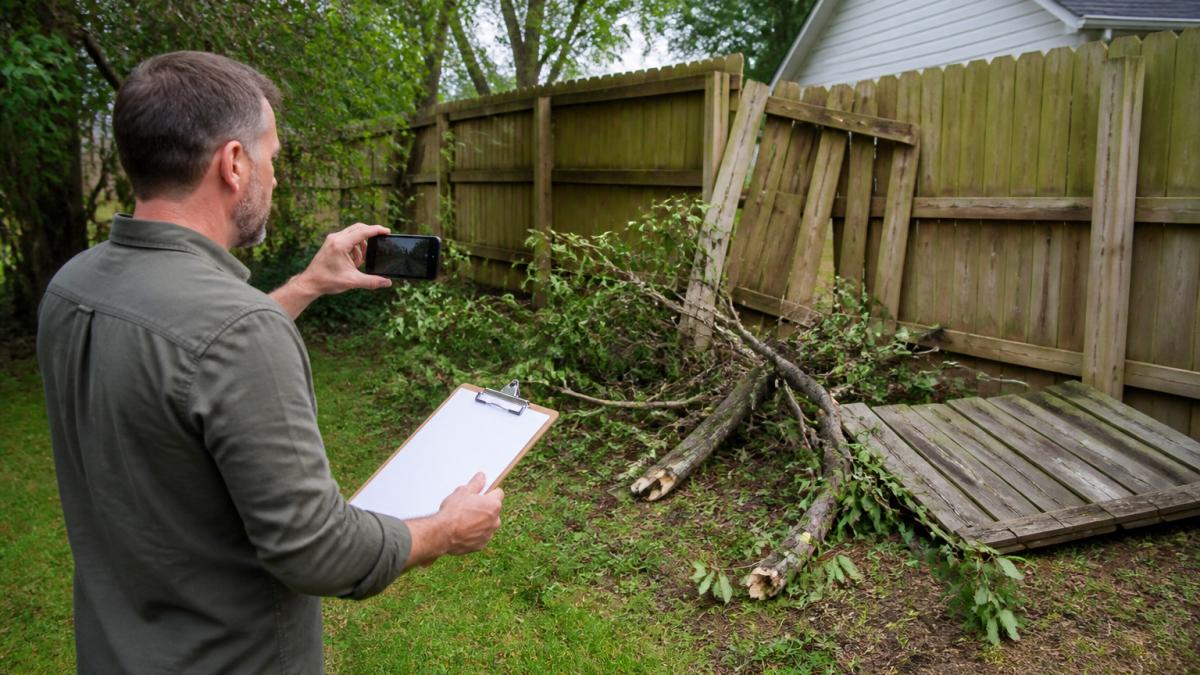
- Take photos and documentation. Capture wide shots and close-ups of the damage.
- Make temporary repairs. Board up or brace the fence to prevent further damage.
- Call your insurer promptly. Report the claim while details are fresh.
- Meet the insurance adjuster. Walk them through the damage in person.
- Get repair estimates. Collect written bids from licensed contractors.
- Review the claim settlement. Confirm the payout covers the approved work.
Documentation Template: What to Photograph and Record
Use this checklist to build a clean claim file. Insurers move faster when the paperwork is complete.
- Date and time of the damage
- Wide photos of the whole fence line
- Close-ups of each damaged panel or post
Photograph the damage from the same angle as your original fence line. Adjusters use before-and-after comparisons to verify the claim, and matching angles speed up approval.
Is It Worth Filing an Insurance Claim for Fence Damage?
Filing a claim only makes sense when the repair cost clearly exceeds your deductible. If your deductible is $1,000 and the repair is $1,200, you are filing a claim for $200.
Here is a simple way to decide:
- Repair cost well above deductible: File the claim.
- Repair cost near the deductible: Pay out of pocket.
- Repair cost below deductible: Skip the claim.
The National Association of Insurance Commissioners consumer resources notes that too many claims in a short period can affect your premiums. A small fence repair is not worth that risk.
Fence Repair Cost: What Affects the Price and How to Budget
Fence repair cost depends on the material, the extent of damage, and the labor involved. A single broken panel costs far less than replacing a whole fence line.
The biggest cost factors are:
- Material type: vinyl, wood, chain link, or iron
- Scope: one panel versus an entire section
- Post damage: leaning or broken posts cost more to fix
Pricing depends on the material, the size of the repair, and the condition of the existing fence. The best step is to get a written estimate before you decide whether to file a claim.
Shared Fence Ownership and Neighbor Coordination
A shared fence on the property line creates the single most common coverage dispute in fence claims. Whose policy pays? The answer depends on three things: who owns the fence, what your policy says about other structures on the property line, and how your state treats boundary fences.
Step 1: Determine Who Owns the Fence
Ownership is not always obvious. Use these signals:
- The survey. A recent plat or survey shows the property line. If the fence sits entirely on your side, you own it. If it straddles the line, ownership is usually shared.
- The deed and HOA rules. Some subdivisions and HOAs assign boundary-fence responsibility in the covenants. Check before you assume.
- Local ordinance. Many jurisdictions place responsibility on the owner whose side the finished face of the fence faces, or on the owner who built it. Rules vary, so confirm with your local building or planning office.
Step 2: Understand How Two Policies Interact
If the fence is truly shared, both owners may have a covered loss from the same event. In practice:
- Each owner files a claim under their own Coverage B for their insurable interest.
- Each owner pays their own deductible.
- The insurer may pay only the portion of the fence the policyholder owns or is legally responsible for.
This is why two neighbors can file claims for the same storm and receive very different checks.
Step 3: Coordinate Before You File
Filing without talking to your neighbor is the fastest way to turn a repair into a dispute. A workable sequence:
- Confirm the line. Pull your survey or plat before any conversation.
- Document the damage together. Take shared photos with both of you present if possible.
- Agree on scope. Get one or two written estimates both of you have seen.
- Decide who files. If the fence is shared, each owner typically files with their own insurer for their interest.
- Put the split in writing. A short signed agreement stating who pays what, and when, prevents later arguments.
- Keep receipts. If you pay more than your share, document it in case you need to seek reimbursement.
Neighbors on good terms who want a clean split. A one-page written agreement signed before work starts is worth more than any verbal understanding.
Do not repair or replace a shared fence without notifying your neighbor in writing, even if you are paying. In some jurisdictions, altering a boundary fence without notice can expose you to a claim from the neighbor.
If your neighbor refuses to cooperate, your own policy still responds to your insurable interest in the fence. Document the refusal in writing and proceed with your claim, do not let the dispute stall your repair.
Conclusion
Fence damage claims get complicated fast, and one wrong step can cost you a payout. Knowing your policy terms, your deductible, and your documentation needs puts you in control.
If your fence needs repair or replacement, Fence Company Lincoln can help. We are family owned, fully licensed, insured, and bonded, and we never subcontract our work. Our team handles everything from design to completion, with a price matching policy to keep your project affordable.
Frequently Asked Questions
Does homeowners insurance cover fence repair after a storm?
Storm damage, including wind and hail, is typically a covered peril under homeowners insurance fence damage coverage. If a storm knocks down panels or damages posts, your policy may pay to repair or replace the fence, minus your deductible. However, coverage depends on your specific policy terms and whether the damage was sudden and accidental. Normal wear and tear from age or lack of maintenance is not covered. File your claim promptly and document all damage with photos before making temporary repairs.
How do I file a fence damage insurance claim?
To file a fence damage insurance claim, start by documenting the damage with photos and notes. Contact your insurer promptly to report the loss and get a claim number. Make temporary repairs to prevent further damage, but keep receipts and avoid permanent repairs until the adjuster inspects. Provide any police reports for vandalism. The adjuster will assess the damage and determine your payout based on Coverage B limits and your deductible. Keep all correspondence and records until the claim is settled.
Is it worth filing an insurance claim for fence damage?
Whether it's worth filing an insurance claim for fence damage depends on your deductible and the repair cost. If the damage is less than or close to your deductible, paying out of pocket may be better to avoid a premium increase. For example, if your deductible is $1,000 and repairs cost $1,200, filing a claim nets you only $200 but could raise your rates. However, if damage is extensive, such as a fallen tree destroying multiple sections, filing may be worthwhile. Consider your claims history and policy terms before deciding.
What fence damage is usually excluded from homeowners insurance?
Homeowners insurance typically excludes fence damage from wear and tear, lack of maintenance, rust, rot, insect infestation, and gradual deterioration. Damage caused by earth movement, such as settling or sinkholes, is also usually excluded. If your fence was already in poor condition, the insurer may deny the claim or reduce the payout. Additionally, some policies exclude damage from certain events like floods, which require separate flood insurance. Always review your policy exclusions to understand what's not covered.