 ultimate-guide
How to Choose Commercial Security Fencing for Property
Table of Contents
- Start With a Site Assessment and Threat Level Definition
- Compare Commercial Security Fencing Materials and Climb Deterrence
- Zoning Ordinances, Fence Height Restrictions, and Compliance
- What Commercial Fence Installation Cost Actually Covers
- High-Security Fencing Standards and Smart Technology Integration
- Your Fence Contractor Evaluation Checklist
- Maintenance, Liability, and Post-Installation Inspections
- Conclusion
- Frequently Asked Questions
Last Updated: September 26, 2026
Start With a Site Assessment and Threat Level Definition
Choosing the right commercial security fencing begins with a site assessment, not a product catalog. Fence Company Lincoln has installed and repaired perimeter fencing across commercial, residential, and multi-site properties for over 30 years.
Mapping Your Property Boundary and Access Points
Walk the full perimeter before requesting a quote. Mark every gate, utility opening, and blind spot where the fence line meets a building or retaining wall.
- Note the total linear footage and any grade changes
- Identify primary and secondary access points
- Flag areas hidden from lighting or camera coverage
- Record existing structures the fence must tie into
Matching Security Level to Your Actual Risk
Not every commercial application needs a high-security standard: a lit retail lot differs from a storage yard holding high-value equipment.
Compare Commercial Security Fencing Materials and Climb Deterrence
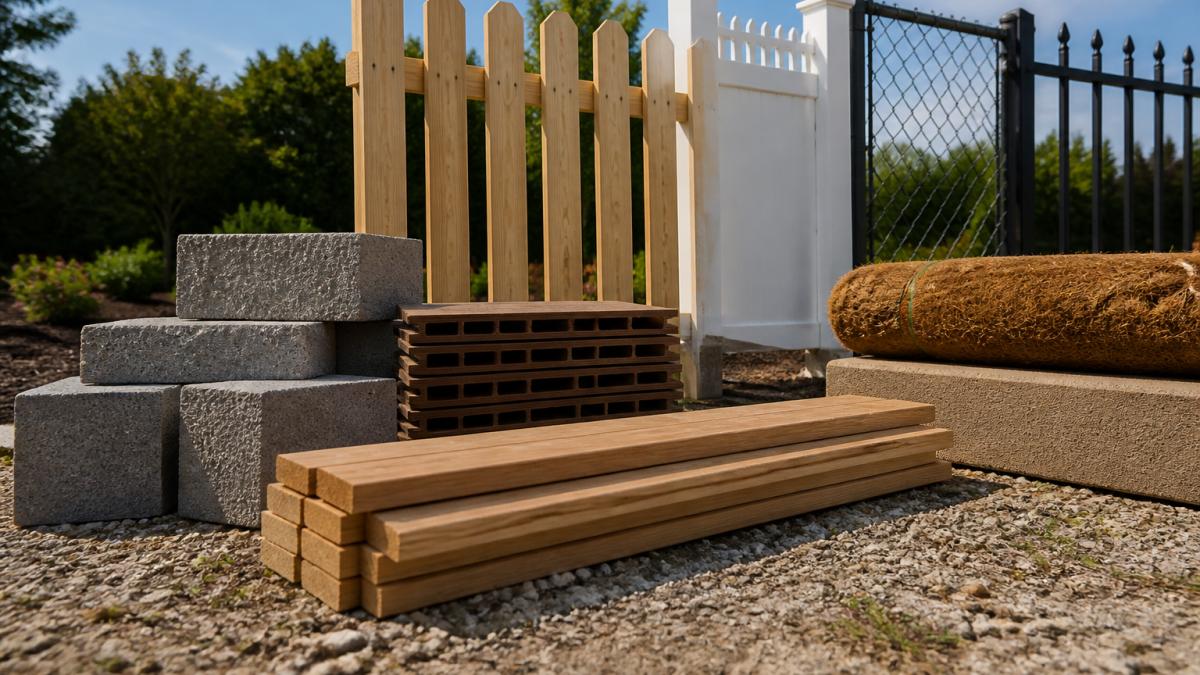
Material choice comes down to four variables: security level, climate, appearance, and service life. Each option trades off cost, visibility, climb resistance, and durability, so ask every bidder to quote these specs in writing.
Chain Link, Welded Mesh, and Palisade Fencing
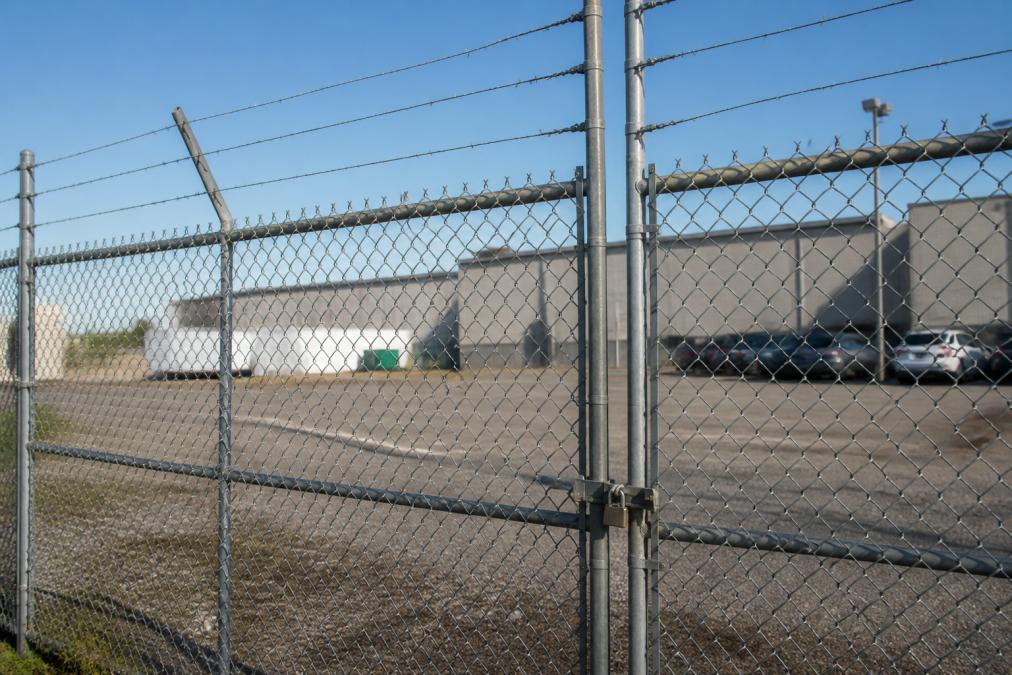
Chain link remains the most common commercial fence: galvanized steel resists corrosion, installs quickly, and offers clear sightlines for cameras. Key specs:
- Fabric gauge: 9-gauge and 11.5-gauge are the common commercial choices. Heavier gauge resists cutting and deformation; lighter gauge is cheaper but deforms under impact.
- Mesh size: 2-inch diamond mesh is standard. 1-3/4-inch or 1-5/8-inch mesh tightens the weave and slows climbing and cutting.
- Coating: Galvanized (Class 1 or Class 2 zinc coating per ASTM A392) is the baseline. Vinyl-coated or powder-coated over galvanized adds color and roughly doubles corrosion life in coastal or de-icing-salt environments.
- Framework: Line posts commonly run 2-3/8-inch or 2-7/8-inch OD, terminal posts 3-1/2-inch or 4-inch OD, top rail 1-5/8-inch. Undersized posts are the most common shortcut in low bids.
Ornamental Iron, Steel, and Wood Options
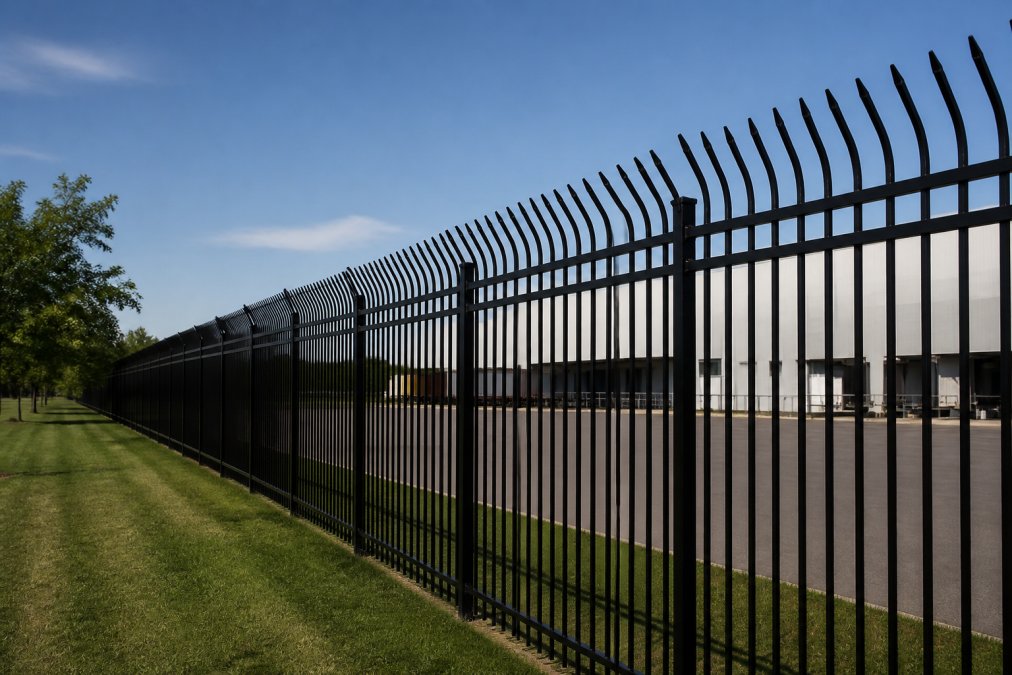
Ornamental iron and steel fencing deliver a high-security look without sacrificing curb appeal, which matters for customer-facing properties. Look for pickets spaced no more than 4 inches apart, and specify powder-coated finishes over a galvanized or zinc-rich primer in wet climates. Aluminum ornamental systems cost less than iron, never rust, and suit retail and office frontage.
| Material | Typical Security Level | Maintenance | Best For |
|---|---|---|---|
| Chain link (9-ga, 2-in mesh) | Moderate | Low | Industrial sites, parking lots |
| Chain link (11.5-ga, 1-5/8-in mesh) | Moderate-High | Low | Higher-deterrence perimeters |
| Welded mesh (6-10 ga) | Moderate-High | Low | Vandalism-prone facilities |
| Palisade (8-12 ga) | High | Low | High-security perimeters |
| Ornamental iron/aluminum | Moderate-High | Low | Customer-facing properties |
| Wood | Low-Moderate | High | Screening, aesthetic boundaries |
Climb-Deterrent Features That Actually Work
Height alone does not stop a determined climber; removing handholds and footholds does:
- Barbed wire and barbed tape: Three strands of barbed wire on outriggers angled outward is the common commercial spec. Barbed tape (concertina) is denser and harder to cut but more visible and sometimes restricted by local ordinance.
- Rotating tops and anti-climb collars: A free-spinning top rail or smooth collar at the top of the fence denies a grip, common on palisade and welded mesh systems.
- Small mesh and tight picket spacing: Openings under roughly 2 inches deny a toehold. This is why 1-5/8-inch chain link and 2-inch welded mesh outperform standard 2-inch diamond mesh against climbing.
- Flush tops and no projections: Any horizontal rail, brace, or sign bracket is a step. Keep the top of the fence clean and mount signage on separate posts.
Zoning Ordinances, Fence Height Restrictions, and Compliance
Zoning ordinances and fence height restrictions vary by jurisdiction, and commercial properties often face stricter rules than residential ones. Confirm local requirements before ordering materials.
What Commercial Fence Installation Cost Actually Covers
Commercial fence installation cost depends on linear footage, material, terrain, gate count, and site access, so no single figure applies. Be skeptical of any quote delivered without a site visit.
Typical Installed Cost Ranges by Material
- Chain link, galvanized: roughly $15 to $30 per linear foot installed for standard 6-foot height, depending on gauge, mesh, and post size. Vinyl-coated adds roughly 20 to 40 percent.
- Welded mesh: roughly $25 to $50 per linear foot installed, driven by wire gauge and panel size.
- Palisade: roughly $40 to $80 per linear foot installed, with the higher end for heavier gauge and through-fixed pales.
- Ornamental aluminum or iron: roughly $30 to $70 per linear foot installed, with iron at the top of the range.
- Wood: roughly $20 to $45 per linear foot installed, depending on species, height, and post system.
Add gates separately. A manual swing or slide gate and automated gates with operators, safety loops, and access control vary in cost depending on width and hardware. Height, terrain, and rock or concrete removal push the number up.
What a Complete Quote Should Itemize
A complete quote should itemize:
- Materials, including posts, rails, fabric, and hardware, with gauge and coating stated
- Post depth and concrete specification (diameter and bag count per hole)
- Gate fabrication and hardware, including hinges, latches, and operators
- Labor and equipment, including any rock or concrete removal
- Permitting and disposal of old fencing
- Restoration of turf, asphalt, or concrete disturbed during installation
The line item most often cut is post depth. Shallow posts are the leading cause of leaning fences within a few years, and repairs cost more than doing it right. A common commercial standard is posts set roughly one-third of their length in concrete, with hole diameter at least three times the post diameter.
How Fence Specifications Affect Insurance and Liability
Commercial property insurance premiums and liability exposure are shaped by the perimeter you build and the records you keep.
- Documented maintenance lowers liability risk. If an incident occurs, a log showing scheduled inspections and repairs demonstrates reasonable care. Insurers and defense counsel both weigh this.
- Layered perimeter security can support premium credits. Many commercial carriers offer reduced rates when a property shows a fence combined with lighting, cameras, and access control. Requirements vary, so ask your agent before finalizing the design.
- Specification affects claims. A fence that meets the local code and the carrier's stated minimum height and material is easier to defend than one that does not. Get the carrier's requirements in writing and hand them to the contractor.
- Gate and access control records matter. Automated gates that log entry and exit create an audit trail supporting both security and claims handling.
How to Compare Bids Without Getting Burned
Normalize every bid to the same scope before comparing:
- Convert each quote to a per-linear-foot figure for the fence and a separate figure for gates.
- Confirm the gauge, mesh size, coating class, and post dimensions match across bids.
- Confirm post depth and concrete spec are stated, not assumed.
- Confirm whether permitting, disposal, and site restoration are included.
- Confirm the warranty length and what it covers (materials only vs. materials and labor).
A bid that is 20 percent lower almost always differs on one of these five points. Find out which before you sign.
High-Security Fencing Standards and Smart Technology Integration
High-security fencing standards combine the physical barrier with detection and response. A fence alone deters; one integrated with technology catches what deterrence misses.
Access Control, Intrusion Detection, and Gate Automation
Gate automation ties entry to your access control system, logging every vehicle and person entering the site. Fence-mounted intrusion detection sensors alert when the fence line is disturbed, cut, or climbed.
Your Fence Contractor Evaluation Checklist
A fence contractor evaluation checklist keeps the hiring decision objective. Use the same criteria for every bidder so you compare like for like.
- Current license number, verified with the state or local authority
- Certificate of insurance covering general liability and workers' compensation
- Bonding documentation
- Written scope with post depth and concrete spec
- Confirmation of whether work is subcontracted
- Installation timeline with start and completion dates
- Warranty terms in writing
- References from comparable commercial projects
Licensing, Insurance, and Installation Timelines
Verify licensing and insurance before work begins. If a crew member is injured on your property and the contractor is uninsured, the liability can land on you.
Maintenance, Liability, and Post-Installation Inspections
Maintenance and post-installation inspections protect the investment and your liability position. A fence's structural integrity degrades quietly without a schedule.
- Check posts for lean, rot, or corrosion at ground level
- Test gate hardware and automation for proper closure
- Inspect fabric for cuts, sagging, or climbing damage
- Confirm lighting and sensors along the fence line still function
- Photograph and log findings for your records
Conclusion
Commercial perimeter security fails when treated as a purchase instead of a system. Secure properties start with a threat assessment, match material and height to real risk, and keep the fence maintained and integrated with detection.
Frequently Asked Questions
What type of fence is best for commercial property security?
The best choice depends on your threat level and budget. For high-security facilities, palisade fencing and welded mesh with anti-climb features offer the strongest deterrence. Chain link with galvanized steel coating works well for general perimeter security at a lower cost. Ornamental iron provides both security and curb appeal. A site assessment helps match the right material to your specific risks, property boundary layout, and access control needs.
How do I determine the appropriate height for a commercial security fence?
Most commercial security fencing runs 6 to 8 feet tall, with high-security facilities going up to 10 feet or more. Local zoning ordinances set maximum fence height restrictions, so check those first. Beyond height, climb-resistant features like anti-climb mesh, rotating spikes, or fence toppings add real deterrence. A 7-foot fence with anti-climb design often outperforms a plain 8-foot fence. Your contractor should confirm compliance before ordering materials.
How does commercial fence installation cost break down?
Commercial fence installation cost depends on linear footage, material type, terrain, gate count, and removal of old fencing. Labor, post depth, concrete, and site access also affect the total. Pricing depends on your specific project scope, so request a detailed written quote that separates materials, labor, and any permit fees.
What should be on a fence contractor evaluation checklist?
A solid fence contractor evaluation checklist includes verifying state licensing, insurance coverage, and bonding. Ask whether the company uses subcontractors or its own crews, since that affects accountability and timelines. Request local references for similar commercial projects, confirm warranty terms on both materials and installation, and get a written timeline. A contractor who answers these questions directly and provides documentation is worth hiring.