 comparison
Chain Link vs Iron Fencing for Commercial Security
Table of Contents
- Feature Comparison: Chain Link and Iron at a Glance
- Security Levels and Intrusion Resistance Compared
- Durability and Longevity: Galvanized Steel vs. Ornamental Iron
- Commercial Chain Link Fence Specifications to Know
- Commercial Fence Installation Costs: Material vs. Labor
- Security Fence Maintenance Tips for Both Materials
- Beyond the Barrier: Smart Security, Zoning, and TCO
- Frequently Asked Questions
Last Updated: September 8, 2026
Choosing between chain link vs iron fencing for commercial security balances upfront budgets against long-term liability. At Fence Company Lincoln, we have installed both systems for over 30 years.
Chain link is a galvanized steel mesh barrier prioritizing visibility and cost efficiency, while iron fencing (typically ornamental steel or aluminum) is a welded, rigid barrier for intrusion deterrence and aesthetic permanence. This guide compares the two across security, durability, maintenance, and total cost of ownership.
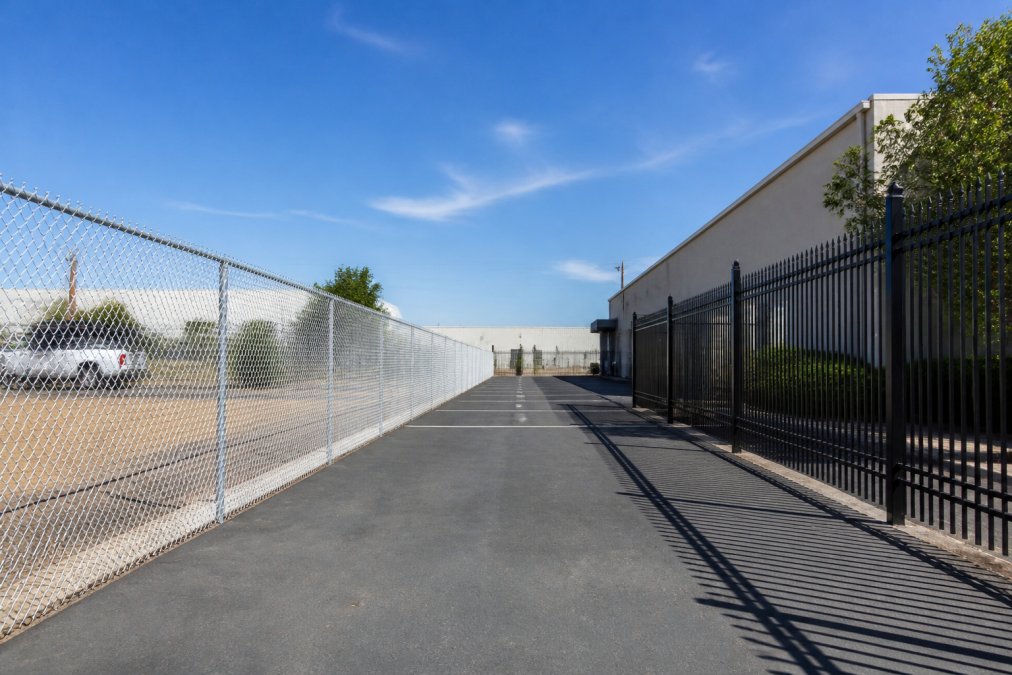
Feature Comparison: Chain Link and Iron at a Glance
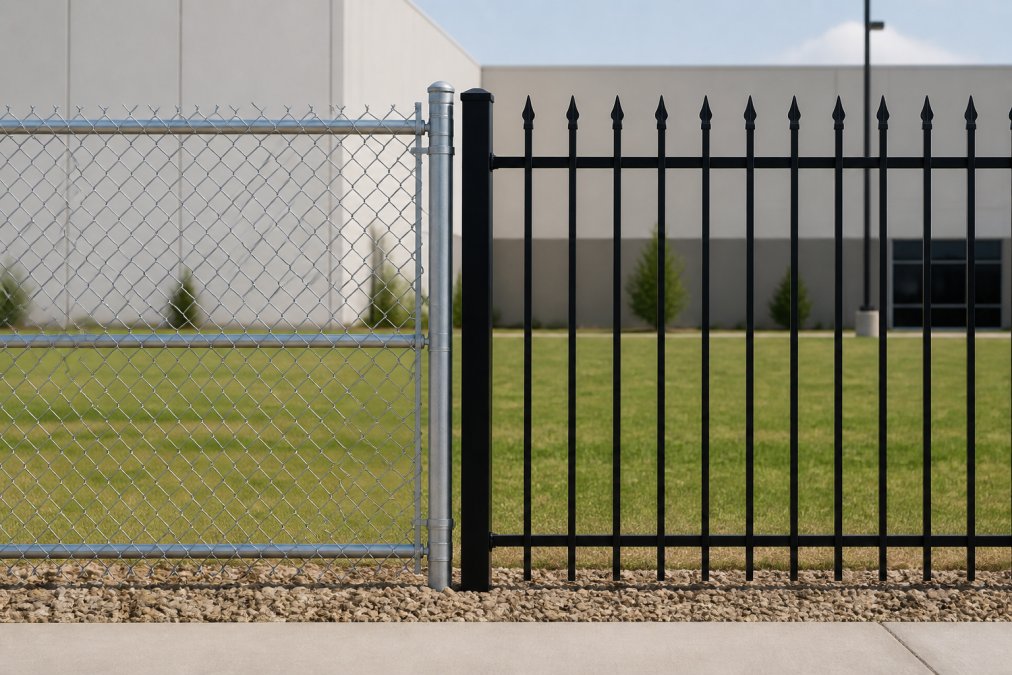
The fastest way to frame the chain link vs iron fencing for commercial security debate is to look at the core trade-offs. Chain link is the workhorse of large perimeters, offering rapid installation and low material cost. Iron fencing delivers higher physical deterrence and a professional appearance.
| Feature | Galvanized Chain Link | Ornamental Steel/Iron | Vinyl-Coated Chain Link | Aluminum Ornamental |
|---|---|---|---|---|
| Starting Price (per linear foot) | $13 - $22 | $45 - $90 | $15 - $40 | $20 - $55 |
| Primary Strength | Cost-effective coverage | Intrusion resistance | Corrosion resistance | Rust-proof, low maintenance |
| Best For | Large perimeters, budget focus | High-security, curb appeal | Harsh climates | High-end look, minimal upkeep |
| Main Drawback | Easier to climb | Higher upfront cost | Coating can be damaged | Less impact resistance |
The price gap is substantial but narrows when factoring in longevity and breach costs. A chain link fence is an effective boundary marker but not a climb-resistant barrier. Iron fencing, with vertical pickets and welded construction, forces intruders to work significantly harder.
Security Levels and Intrusion Resistance Compared
Iron fencing wins decisively on security and intrusion resistance. The welded construction of ornamental steel provides superior structural integrity, and vertical pickets make climbing significantly more difficult than chain link's diamond mesh. For sites holding valuable inventory or data, that difference is the entire point.
Chain link's weakness is climbability. The mesh offers natural footholds, and a determined person can scale an 8-foot fence in seconds without tools. Barbed or razor wire improves deterrence but signals a high-threat environment undesirable for customer-facing properties. Iron fencing can be specified with security-focused top designs without the harsh visual of concertina wire.
No fence is impenetrable. The goal is to delay intrusion long enough for detection and response. Pairing either material with intrusion detection systems and cameras turns a passive barrier into a genuine security asset. Chain link's visibility can be an advantage, allowing clear sightlines for surveillance.
Durability and Longevity: Galvanized Steel vs. Ornamental Iron
Both materials are built to last but age differently. Galvanized chain link uses a zinc coating for corrosion resistance. A quality installation can serve for decades, though the zinc degrades over time, especially in coastal or industrial environments where salt and chemicals accelerate corrosion.
Ornamental steel relies on a powder-coated finish to prevent rust. The finish can be scratched or chipped by impacts, exposing steel to oxidation. Aluminum ornamental fencing eliminates this concern, as it is naturally rust-resistant and requires no regular painting. For humid climates or chemical exposure, aluminum offers iron's longevity without the maintenance burden.
Vinyl-coated chain link adds a protective layer over the galvanized core, enhancing resistance to salt, moisture, and chemicals, and is available in multiple colors. The trade-off is that the coating can be damaged by sharp tools or heavy impact, exposing the steel.
Commercial Chain Link Fence Specifications to Know
For commercial chain link fence specifications, key variables are mesh gauge, mesh size, and coating weight. Gauge refers to wire thickness; lower numbers mean thicker, stronger wire. Residential fences might use 11.5 or 12.5 gauge, but commercial perimeters typically require 9 or 6 gauge for greater tensile strength.
Mesh size matters. Smaller openings, such as 1 inch or 1.5 inches, make the fence harder to climb. Larger mesh, like 2.25 inches, is more economical but offers easier handholds. For security-focused installations, specify smaller mesh and thicker wire, and ensure posts are set deep enough to resist cutting tools.
Coating is equally important. Galvanized coating weight is measured in ounces per square foot; heavier coatings provide longer service life. In corrosive environments, consider vinyl-coated chain link for enhanced resistance. The smoother finish also reduces snagging or injury risk for pedestrian traffic.
Commercial Fence Installation Costs: Material vs. Labor
Understanding the true cost of a commercial fence requires dissecting the quote into components. Your final price is driven by material choice, site conditions, and labor rates that vary by region and season.
Breaking Down the Material Costs
Material cost per linear foot is the most straightforward part of the estimate. It includes fence fabric or panels, posts, rails, gates, and all necessary hardware (clamps, brackets, concrete for post setting).
Chain Link Material Costs: Price is driven by gauge, mesh size, and coating type. A standard 9-gauge galvanized chain link with 2-inch mesh costs less than a 6-gauge security-grade fence with 1-inch mesh. Coating is a major variable:
- Galvanized: The baseline, offering good corrosion resistance at lower prices, but the zinc degrades over time in harsh environments.
- Vinyl-Coated: Adds a PVC layer in black, brown, or green. Costs roughly 20-30% more than bare galvanized but offers superior resistance to salt, chemicals, and UV degradation.
- Aluminum-Coated (Aluminized): A less common but highly durable option, offering better corrosion resistance than zinc in industrial and coastal environments.
Iron and Steel Material Costs: Ornamental steel is priced by material weight and design complexity. Key factors include:
- Bar Thickness: Standard pickets are 1/2-inch or 5/8-inch square bar. Heavier bar stock (3/4-inch or 1-inch) is significantly more expensive but provides greater impact resistance.
- Panel vs. Custom Fabrication: Pre-fabricated panels are more economical. Custom fabrication for specific heights, widths, or designs (e.g., spear tops, scrolls) adds cost.
- Finish: Powder-coating is a significant cost component. A two-coat system (primer + color) costs more than a single-coat finish but offers superior longevity.
- Aluminum Alternative: Typically priced between chain link and steel. It is lighter, reducing shipping and installation labor, but the material is more expensive per pound than steel.
The Labor Cost Drivers: What Your Contractor is Pricing
Labor is where quotes can vary by 20-50% for the same material. Primary drivers include:
1. Site Conditions and Terrain:
- Soil Type: Rocky or clay-heavy soil is slower to dig and may require specialized equipment. Sandy or loamy soil is easier.
- Slope and Grade: Sloped fencing requires stepping or racking to follow the contour, adding labor time and material waste.
- Obstructions: Trees, utility lines, and buried cables must be worked around, often requiring slower hand-digging in tight areas.
2. Perimeter Length and Layout:
- Economies of Scale: Cost per linear foot decreases as total length increases because setup and mobilization costs are spread over more footage.
- Number of Corners and Gates: Each corner requires a heavier terminal post and more bracing. Each gate adds frame, hinge, latch, and installation costs. A simple perimeter with few corners and one gate is most economical.
3. Regional Labor Rates:
- Labor costs are higher in metropolitan areas with a high cost of living and strong construction demand. Union vs. non-union markets also affect rates.
4. Permitting and Inspection Fees:
- Often passed through to the client. Permit fees vary by municipality, typically ranging from $50 to $500 for a commercial fence. Inspection fees may be included or billed separately.
A Realistic Budgeting Framework
To avoid sticker shock, use this framework when evaluating quotes:
- Get a Site-Specific Quote: Do not rely on online calculators or national averages. These do not account for your soil, slope, or local labor rates.
- Request an Itemized Breakdown: A professional quote should separate material, labor, and subcontracted work (e.g., concrete, electric for gates) for apples-to-apples comparison.
- Ask About Site Prep: Tree trimming, debris removal, or grading are often not included in the base quote and can add significant cost.
- Clarify the Post-Setting Method: Concrete footings are standard. Depth and diameter must meet local frost line and wind load requirements. A shallow footing is a common cost-cutting measure that compromises stability.
- Plan for the Unexpected: Set aside a contingency of 10-15% for unforeseen site conditions, such as bedrock or unmarked utility lines.
The Real Cost of Gates
Gates are often the most expensive single component. A basic 12-foot chain link gate with a manual latch might cost $800-$1,500 installed (fenceauthority.com). A 12-foot ornamental steel gate with a commercial-grade electric operator, access control keypad, and safety sensors can easily cost $5,000-$10,000 or more. Operator size is determined by gate weight; heavier iron gates require more powerful operators (ditecentrematic.com). Do not underestimate automation and access control costs.
Security Fence Maintenance Tips for Both Materials
Security fence maintenance is where the two materials diverge most sharply. Chain link is largely a "set and forget" system. The galvanized coating protects the steel, with no paint to chip or rust to treat. Primary maintenance is inspecting for lifted fabric, loose tension, or corroded spots. Vinyl-coated chain link requires similar checks, with attention to nicks exposing the steel core.
Ornamental steel demands more attention. Scratches from impacts, equipment, or vandalism need prompt touch-up to prevent rust from spreading. An annual inspection and immediate repair of coating damage will extend the fence's life significantly. Aluminum ornamental fencing reduces this burden to near zero, as it requires no painting and will not rust.
Regardless of material, the gate is the most vulnerable point. A sagging gate that will not close properly is an open invitation. Inspect hinges, latches, and posts annually, and address issues before they compromise the barrier. For commercial properties, a proactive maintenance schedule is a liability control measure.
Beyond the Barrier: Smart Security, Zoning, and TCO
This section moves the chain link vs iron decision beyond a simple material choice into a strategic security investment. Most comparison articles stop at physical attributes; here, we address integration with smart systems, regulatory compliance, and true total cost of ownership.
Smart Security Integration: Turning a Barrier into a Sensor Platform
The physical fence is your first line of defense, but its value multiplies when integrated with electronic systems. The material you choose directly affects how you deploy these technologies.
Fiber Optic Vibration Detection: Uses a buried or attached fiber optic cable to detect vibrations from climbing, cutting, or lifting, pinpointing the exact intrusion location. For chain link, the cable is often woven through the mesh, turning the entire fence into a sensor. For iron, the cable runs along the bottom rail or is buried in the footing. Iron's rigid nature can reduce false alarms from wind-induced vibration, a common chain link issue on exposed sites.
CCTV Mounting and Sightlines: Chain link's open mesh provides unobstructed camera views, allowing cameras inside the perimeter to monitor the property line, a significant advantage for large lots. Iron fencing, especially with solid panels or dense picket spacing, can create blind spots, requiring cameras on poles or building corners. Consider the camera's field of view and mounting height so the barrier does not become an obstruction.
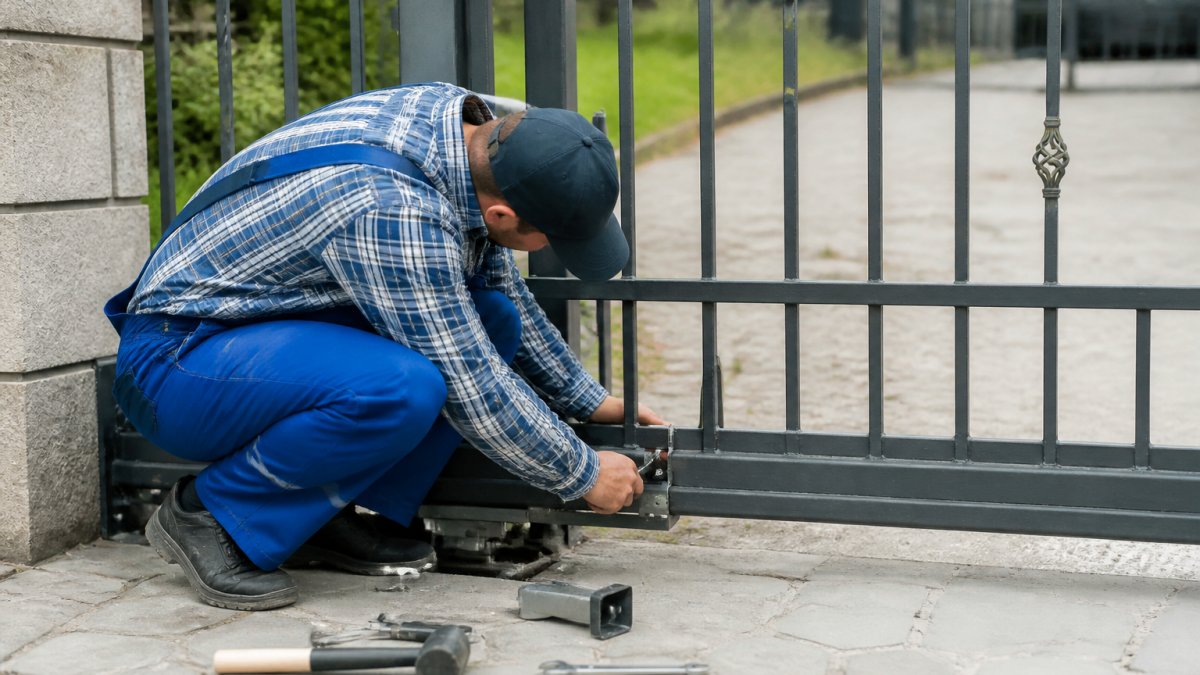
Access Control Integration: Both fence types can integrate with card readers, keypads, and intercoms at gates. The key difference is structural. Iron gates are heavier and require heavier-duty operators; a residential-grade operator is insufficient. Chain link gates are lighter, allowing for smaller, less expensive operators, but the frame must still be reinforced to prevent sagging and forced entry. For high-security sites, consider a crash-rated gate system, more commonly specified in steel.
A Practical Integration Checklist: Work with your security integrator to map out:
- Cable pathways for power and data (conduit runs along the fence line)
- Location of junction boxes for sensors and cameras
- Type of fence-mounted lighting (e.g., LED floodlights on poles, not on the fence fabric)
- Redundancy for communication links (wired vs. wireless)
Regulatory and Zoning Compliance: The Non-Negotiable Spec
A fence that violates local codes is a liability, not an asset. Zoning ordinances and building codes govern fence height, setback from property lines, and materials, varying significantly by municipality and zoning district.
Height Restrictions: Commercial zones often permit taller fences than residential zones, but limits still apply. A common maximum is 8 feet in the front or street-facing yard and 10 feet in the rear or side yards (iccsafe.org). Some industrial zones may allow up to 12 feet with a special permit. Exceeding the allowed height can result in fines, a stop-work order, and required removal or modification at your expense.
Setback Requirements: Setbacks dictate how far the fence must be from the property line, often to maintain sightlines for traffic or allow utility access. Building on the property line itself may be prohibited, requiring installation a foot or more inside your boundary, affecting usable lot area and total linear footage needed.
Material and Design Restrictions: Some municipalities restrict barbed wire, razor wire, or electrified fencing in commercial districts, particularly near residential areas or public rights-of-way. This is critical if you plan to add these features to a chain link fence. Ornamental iron with spear-top pickets may also face restrictions in historic districts or planned unit developments (PUDs).
The Permitting Process: Most commercial fence installations require a building permit, typically requiring a site plan showing fence location, height, and materials. Your contractor should handle this, but you are ultimately responsible for compliance. Verify your contractor is familiar with local codes and will pull necessary permits. Failure to do so can create title issues when you sell the property.
Total Cost of Ownership (TCO): A 10-Year Financial Model
The upfront price per linear foot is the most visible number but not the most important. A 10-year TCO analysis provides a clearer picture of the financial commitment, including initial material and installation, plus annual maintenance, expected repair costs, and residual asset value.
Assumptions for a Comparative Model: The following are representative cost ranges, not quotes, and assume professional installation on flat, prepared ground.
| Cost Component | Galvanized Chain Link (6 ft, 9-gauge) | Ornamental Steel (6 ft, 3/16" bar) |
|---|---|---|
| Initial Material & Installation | $7,500 - $11,000 | $22,500 - $45,000 |
| Annual Maintenance (labor & materials) | $150 - $300 (inspection, minor tension adjustments) | $500 - $1,000 (touch-up paint, rust spot treatment) |
| 10-Year Maintenance Total | $1,500 - $3,000 | $5,000 - $10,000 |
| Expected Major Repair (Year 5-7) | $500 - $1,500 (replace damaged sections, re-tension) | $1,000 - $3,000 (weld repair, panel replacement after impact) |
| 10-Year Total Cost of Ownership | $9,500 - $15,500 | $28,500 - $58,000 |
| Estimated Service Life | 15 - 20 years (in moderate climate) | 30+ years (with proper maintenance) |
Interpretation: Chain link has a lower 10-year TCO but will likely need replacement within 15-20 years. Iron, while more expensive in the first decade, may last 30 years or more, meaning its 20-year TCO could be lower than replacing chain link twice. For long-term holds, iron's higher initial investment can be justified. For shorter holds or very large perimeters, chain link's lower TCO is compelling.
The Cost of a Breach: This model does not include the cost of a security breach, which can dwarf any fence expense. A single theft of equipment or data can cost tens of thousands of dollars. Factoring in iron's increased deterrence and delay time, the risk-adjusted TCO may favor iron for high-value assets.
Sustainability and Environmental Impact
For property managers reporting on ESG metrics, the fence material's lifecycle matters. Both galvanized steel (used in chain link) and ornamental steel are highly recyclable. At end of service life, the steel can be recovered and recycled, reducing demand for virgin iron ore. Aluminum ornamental fencing is also infinitely recyclable without loss of quality.
The environmental footprint is also about the manufacturing process. Steel production is energy-intensive, but a significant portion of new steel is made from recycled scrap. Iron's longer service life means fewer replacements and less material consumed over a 30-year period. A chain link fence replaced twice in that timeframe has a higher cumulative environmental impact due to manufacturing and transportation of replacement materials.
Choosing a fence that lasts longer and requires less maintenance is often the more sustainable choice, even if the initial carbon footprint is higher. This can be used in sustainability reporting to demonstrate a long-term asset management strategy.
Frequently Asked Questions
What is considered a commercial-grade chain link fence?
Commercial-grade chain link means heavier wire and framework than residential options. Key commercial chain link fence specifications include 11.5 or 6 gauge galvanized steel wire, a top rail of 1 3/8 inch diameter, and posts set in concrete. Mesh sizes are typically 2 inches or smaller. Look for a Class A galvanized coating for maximum corrosion resistance. These specs ensure the fence can withstand impact and resist climbing, making it a serious security barrier.
Which fence is a stronger deterrent against intruders: chain link or iron?
Ornamental iron is the stronger physical deterrent. Its welded steel pickets are difficult to cut and its vertical design offers minimal footholds, making it highly climb-resistant. While chain link is tough, it can be scaled more easily. For high-value assets or sites requiring strict access control, iron's structural integrity is superior. Chain link remains effective when combined with barbed wire integration or intrusion detection systems for a layered perimeter security approach.
What are the primary maintenance differences between iron and chain link?
The maintenance schedules differ significantly. Galvanized chain link is low-maintenance; it mainly needs periodic cleaning to remove dirt and debris and an inspection for any damage to the galvanized coating. Ornamental iron with a powder-coated finish is similarly low-effort, but any chips or scratches must be touched up promptly to prevent rust. For both, a yearly inspection of posts, fittings, and gates is a smart security fence maintenance tip. Aluminum ornamental is an option if you want to avoid rust concerns entirely.
How do commercial fence installation costs compare between chain link and iron?
Commercial fence installation costs are where chain link has a clear advantage. The higher price of iron reflects its material durability, welded panels, and more labor-intensive installation. However, iron's longer lifespan and lower long-term repair needs can offset the initial investment. The final cost depends on the total perimeter length, site evaluation, and local commercial zoning requirements.
Can both chain link and iron fences integrate with smart security systems?
Yes, both materials work with modern security technology. Since chain link offers high site visibility, it is easy to pair with camera systems for clear sightlines. Iron fences, while offering less visibility, can be fitted with access control systems on gates and are excellent backdrops for motion sensors. Integrating either fence with intrusion detection and video surveillance is a best practice. The choice is about which physical barrier best complements your overall security specifications and asset protection strategy.